Read the transcript
Potholing in Newcastle:
how a vac truck crew exposes buried services.
Potholing is digging a small, careful hole to see a buried service before the real excavation starts.
On a building or civil site, that means exposing pipes and cables.
SafeWork NSW's code for work near overhead and underground electric lines, which commenced on 22 May 2026, describes it as digging by hand or other non-destructive means to a pre-determined depth, to verify where mapped assets are or confirm there are no services in that spot.
A vac truck is one of the most practical ways to do it.
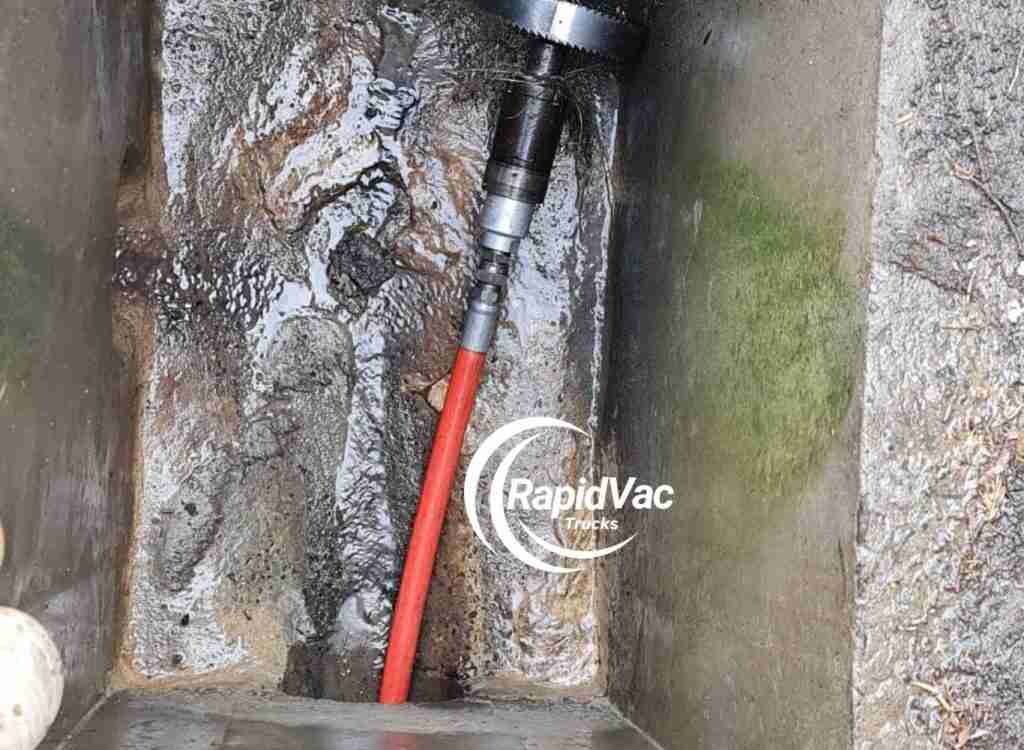
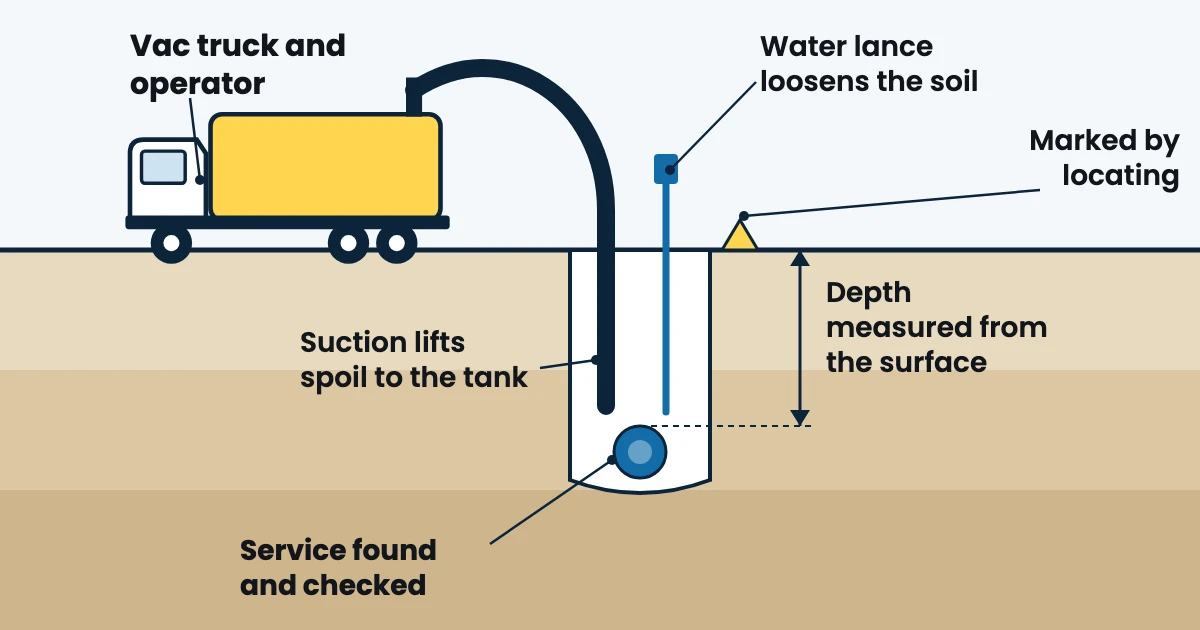
Pressurised water loosens the soil and suction lifts it into the truck's tank, so the service is uncovered without a bucket or blade near it.
Rapid Vac Trucks Newcastle provides potholing services across Newcastle, Lake Macquarie and the Hunter, and the truck always comes with an experienced operator who sets up around your site.
Key takeaways.
Potholing shows you where each buried service really is before you dig, bore or trench.
Before You Dig Australia plans are free and the right start, but they are indicative and usually give no depth.
Around Newcastle, Ausgrid and Jemena build potholing into work near their networks.
Our crew uncovers each service and records its depth, so the main work goes ahead from facts.
When do you need potholing?
You need potholing whenever you are about to dig, bore or trench near buried services and need to know exactly where they are.
SafeWork NSW's Code of Practice for excavation work says service information may not be accurate, so excavation should start with an initial check, for example exposing a short section of the services, usually with water pressure and a vacuum system.
Where an underground cable's exact position cannot be determined, the code says potholing should be used.
SafeWork NSW's newer electric lines code adds that you should contact the asset owner for advice in that situation.
The excavation work code lists gas, water, sewerage, telecommunications, electricity, chemicals, fuel and refrigerant in pipes or lines as essential services.
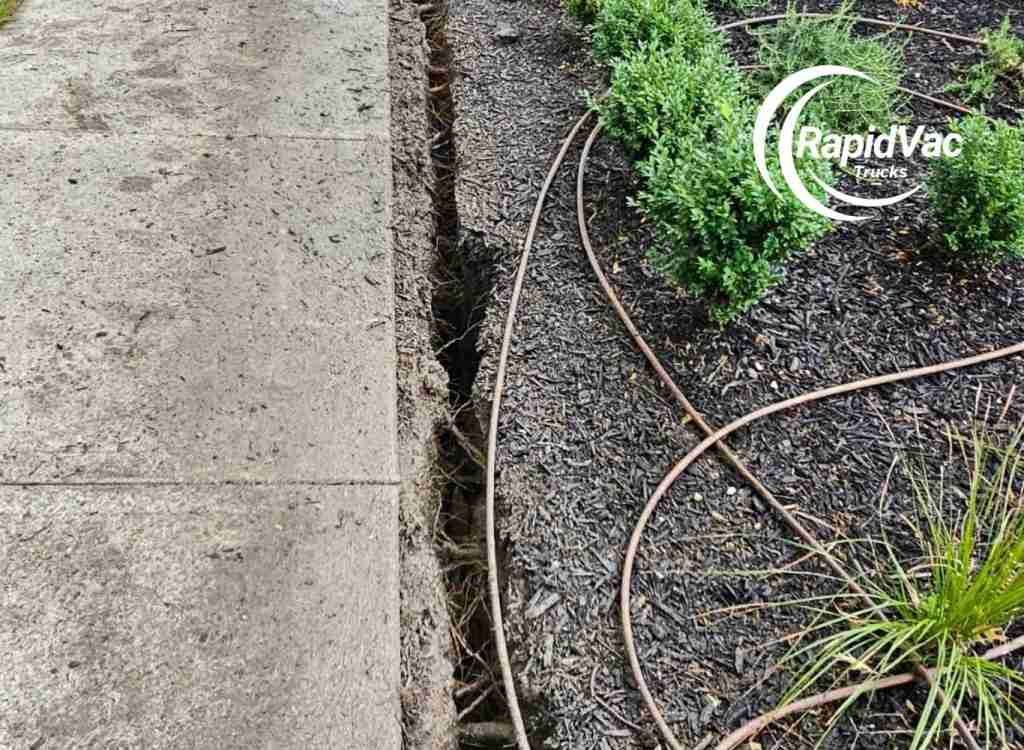
On Newcastle and Lake Macquarie sites that covers trenching for irrigation, cabling or water mains, a new connection near existing services, or a bore under a driveway or road.
The networks around Newcastle add their own rules.
Ausgrid delivers electricity to Sydney, the Central Coast and the Hunter Valley, and Jemena operates gas distribution networks throughout NSW and the ACT.
Ausgrid's network standard, N S one five six, and Jemena's guideline for constructing around its gas network set out the following.
For Ausgrid distribution cables, dig potholes to find the cables first, by hand with non-conductive shovels or by vacuum excavation, and keep mechanical excavation out of 150 mm above the cover strip, 300 mm to the side and 300 mm underneath.
For Ausgrid transmission cables, potholing within 2 m of the cable or conduit needs Ausgrid's written consent.
For boring parallel to Ausgrid distribution cables, keep 2 m between the cable and the bore head, less only in limited cases, and dig a pothole every 10 m along the route to confirm where the cable is.
For Jemena gas distribution mains, locate the main by potholing, keep mechanical excavation out of 600 mm without Jemena's permission, and have a Jemena standby present for work within 3 m of a secondary or critical main.
Why plans and locating are not the end of it.
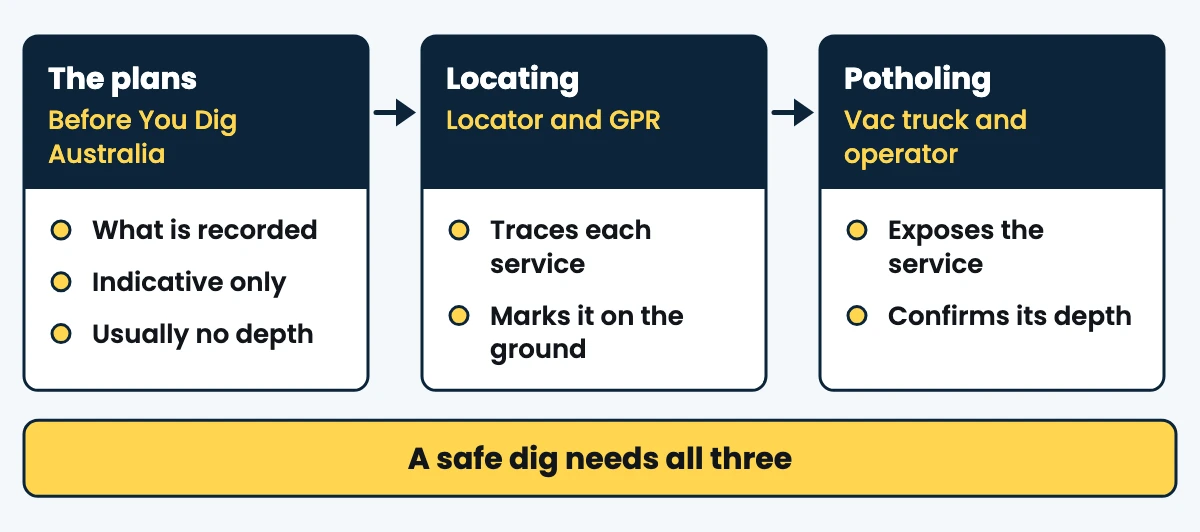
Plans tell you what is recorded, locating marks it on the ground, and potholing confirms it.
A safe dig needs all three.
What the free plans show.
A Before You Dig Australia enquiry is free, but BYDA says the plans are indicative only:
asset owners only record the general locations of their assets, and in most cases depths are not supplied.
Plans expire, and the expiry varies between asset owners, so lodge a new enquiry if they lapse or your scope changes.
Getting every response is not approval to dig.
Some services will not be on the plans at all.
BYDA notes that domestic and privately installed lines, such as irrigation pipes or power to a shed, usually are not shown, and some owners, such as councils, may not be members.
On private property, the excavation work code says to contact the owner or occupier about buried cables before starting.
Plans rarely give depth, so exposing the service is how you confirm it before the main dig.
Where locating fits.
The excavation work code names electromagnetic cable locators and ground penetrating radar as ways for trained operators to locate services.
The electric lines code then says that once a locator has traced the assets, potholing by hydro or vacuum excavation, with the asset owner's permission or supervision, should verify their location if required.
It also says to contact the asset owner before any potholing.
You can book our service locator or ground penetrating radar work first, so the marks are on the ground when the vac truck arrives.
How a vac truck crew potholes.
Our operator uses water to loosen the ground and suction to lift it away, one hole at a time, until the service can be seen and measured.
Potholing excavation with a vac truck runs like this.
Step one, get the plans.
The free plans show what asset owners have recorded and where to start looking.
Step two, locate and mark.
Locating and GPR mark the ground along your dig line, so our operator knows where each pothole goes and where to set up the truck and hose.
Step three, pothole.
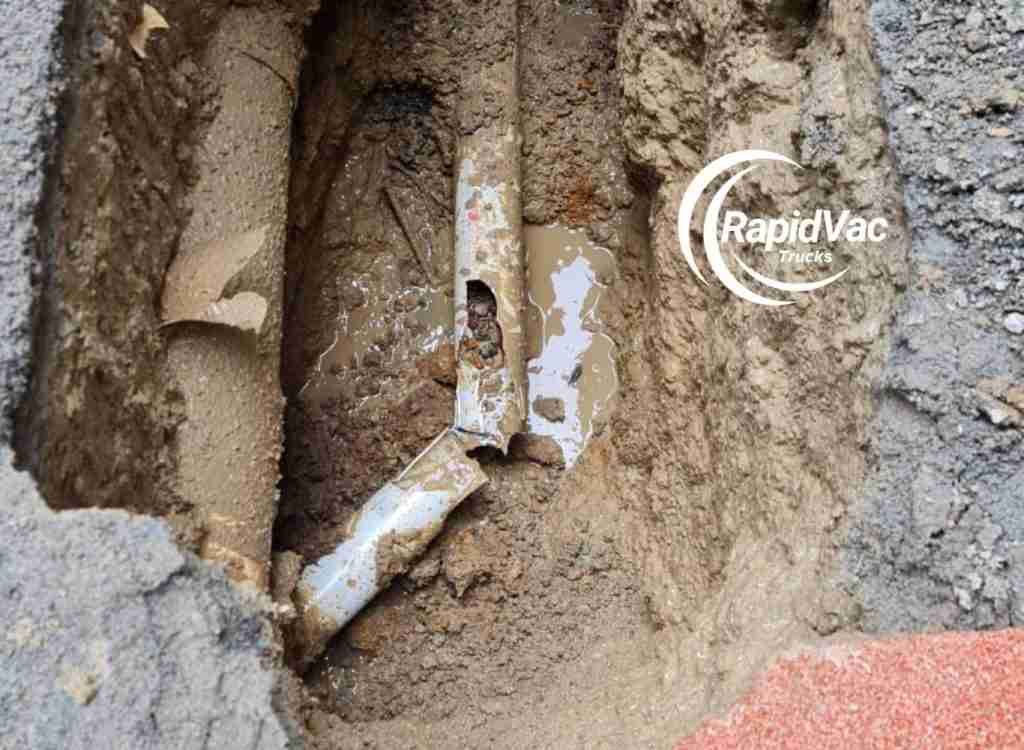
The vac truck exposes each service.
On concrete or asphalt, a machine lifts only the surface, as Ausgrid's standard limits it.
Then the water lance loosens the soil and suction lifts the spoil into the tank.
Step four, measure and record.
With the service in sight, our operator writes down its depth and position.
Jemena's guideline describes the same idea for gas:
visually identify the main, measure its depth and mark the centreline on the ground.
Step five, dig, bore or trench.
The work goes ahead from the record, with machines kept out of the distances the asset owner sets.
Ausgrid and Jemena also set nozzle distances and water pressure limits near their assets.
Our operator works to the owner's conditions for your site, so send the owner's pack with your plans when you book.
One hole is rarely the whole job.
Ausgrid wants potholes close enough together to identify all cables, conduits and services and the profile between them, so a long trench or bore usually means a series of holes.
The codes and Ausgrid also accept hand digging with insulated or non-conductive tools.
A vac truck does the same job and takes the spoil away as it goes, which makes vac truck potholing a clean choice for tight or busy work areas.
You can read more on our vacuum excavation and non-destructive digging pages.
What gets recorded.
The record is the point of potholing:
for each hole, what was found, where and how deep.
Agree the record you need when you book.
A useful one notes the following.
Where each pothole is, tied to the plans or the ground marks.
What service was found, or that nothing was there.
The depth from the surface to the top of the service.
Which way it runs, and anything that was not on the plans.
Photos of the exposed service.
In BYDA's summary of the AS 5488 quality levels, the highest level is validation of assets by visual means, non-destructive digging et cetera.
Keep the record with your plans and pass it to whoever does the main excavation.
The excavation work code also says a safe work method statement, or SWMS, must be prepared for excavation work involving underground services.
Where the spoil goes.
The spoil and water go straight up the suction hose into the truck's tank, so no mud pile is left in the work area.
From there, the NSW EPA says the Protection of the Environment Operations Act, 1997, requires waste to be transported to a place that can lawfully accept it, and both the waste owner and the transporter are responsible for proving it went there.
Tell us about anything unusual in the ground, such as fill or contamination, so disposal is planned with the job.
Our liquid waste removal page covers slurry in more detail.
What to send when you book.
Each potholing job is planned from the site details you send.
Have these ready.
The address and work area:
where the dig, bore or trench will run.
Current Before You Dig plans:
every response, checked for expiry.
BYDA asks for enquiries at least one day before the job is due to begin.
Any locator or GPR mark-out, or ask us to do it first.
The job and its depth:
footings, a connection, a bore or a trench, and how deep the design goes.
The asset owner's conditions, such as Ausgrid's written consent within 2 m of a transmission cable, or a Jemena standby.
Some work near Ausgrid cables, such as boring within 2 m, needs notice to Ausgrid first, so check its requirements early.
Private services the owner or occupier knows about.
Access and surface:
where the truck can stand, gates, overhead obstacles, and any concrete or asphalt to lift.
Your SWMS and induction details.
Call (02) 4012 2214 to talk it through, or upload photos or a site plan with the quote form.
Our vac truck site preparation checklist covers access and set-up, and plumbers can read how hydro excavation helps on plumbing jobs.
The Newcastle team offers a twenty-four seven service, including on-site attendance for urgent and after-hours jobs.
Timing depends on the job, its location and the schedule, and is confirmed when the work is scoped.
Frequently asked questions.
What is potholing?
Potholing is digging a small hole, by hand or with a vac truck, to expose a buried service and confirm where it is, or that nothing is there, before excavation starts.
Do I still need plans if I pothole?
Yes.
Current underground services information must be obtained before excavation, and Before You Dig Australia plans are the usual source.
The plans show where to pothole; potholing confirms what they show.
How deep can a vac truck pothole?
As deep as needed to see the service.
The codes set no standard depth, only a pre-determined one for each job.
SafeWork NSW gives typical depths of 450 to 750 mm for low voltage cables, and 600 to 1000 mm for high voltage distribution, but real depths vary.
Tell us the depth your plans or design call for and the job is planned around it.
Does potholing replace service locating?
No, they work together.
A locator traces and marks services on the ground, then potholing verifies them by exposing them.
That is the order SafeWork NSW's electric lines code describes, with the asset owner's permission or supervision.
What happens to the spoil?
It goes into the vac truck's tank as the hole is dug.
NSW EPA rules require waste to go to a place that can lawfully accept it, and the owner and transporter are both responsible for that.
This guide is general information, not safety or legal advice.
Codes and asset owner conditions change, so check the current SafeWork NSW codes, your Before You Dig Australia plans and the asset owner's pack for your site before work starts.
Sources were checked in November 2026.
To book potholing, call Rapid Vac Trucks Newcastle on (02) 4012 2214, or send your plans through the quote form on our website.
Potholing is digging a small, careful hole to see a buried service before the real excavation starts. On a building or civil site, that means exposing pipes and cables. SafeWork NSW's code for work near overhead and underground electric lines, which commenced on 22 May 2026, describes it as digging by hand or other non-destructive means to a pre-determined depth, to verify where mapped assets are or confirm there are no services in that spot.
A vac truck is one of the most practical ways to do it. Pressurised water loosens the soil and suction lifts it into the truck's tank, so the service is uncovered without a bucket or blade near it. Rapid Vac Trucks Newcastle provides potholing services across Newcastle, Lake Macquarie and the Hunter, and the truck always comes with an experienced operator who sets up around your site.
Key takeaways
- Potholing shows you where each buried service really is before you dig, bore or trench.
- Before You Dig Australia plans are free and the right start, but they are indicative and usually give no depth.
- Around Newcastle, Ausgrid and Jemena build potholing into work near their networks.
- Our crew uncovers each service and records its depth, so the main work goes ahead from facts.
When do you need potholing?
You need potholing whenever you are about to dig, bore or trench near buried services and need to know exactly where they are. SafeWork NSW's Code of Practice: Excavation work says service information may not be accurate, so excavation should start with an initial check, for example exposing a short section of the services, usually with water pressure and a vacuum system. Where an underground cable's exact position cannot be determined, the code says potholing should be used. SafeWork NSW's newer electric lines code adds that you should contact the asset owner for advice in that situation.
The Excavation work code lists gas, water, sewerage, telecommunications, electricity, chemicals, fuel and refrigerant in pipes or lines as essential services. On Newcastle and Lake Macquarie sites that covers trenching for irrigation, cabling or water mains, a new connection near existing services, or a bore under a driveway or road.
The networks around Newcastle add their own rules. Ausgrid delivers electricity to Sydney, the Central Coast and the Hunter Valley, and Jemena operates gas distribution networks throughout NSW and the ACT. Ausgrid's network standard NS156 and Jemena's guideline for constructing around its gas network set out the following:
| Asset | What the operator asks | Distances it states |
|---|---|---|
| Ausgrid distribution cables | Potholes to find the cables first, by hand with non-conductive shovels or by vacuum excavation | No mechanical excavation within 150 mm above the cover strip, 300 mm to the side or 300 mm underneath |
| Ausgrid transmission cables | Ausgrid's written consent before potholing | Within 2 m of the cable or conduit |
| Boring parallel to Ausgrid distribution cables | Potholes along the route to confirm the cable location | 2 m between cable and bore head (less only in limited cases), and a pothole every 10 m |
| Jemena gas distribution mains | Locate the main by potholing | No mechanical excavation within 600 mm without Jemena's permission; a Jemena standby for work within 3 m of a secondary or critical main |
Why plans and locating are not the end of it
Plans tell you what is recorded, locating marks it on the ground, and potholing confirms it. A safe dig needs all three.
What the free plans show
A Before You Dig Australia enquiry is free, but BYDA says the plans are indicative only: asset owners only record the general locations of their assets, and in most cases depths are not supplied. Plans expire, and the expiry varies between asset owners, so lodge a new enquiry if they lapse or your scope changes. Getting every response is not approval to dig.
Some services will not be on the plans at all. BYDA notes that domestic and privately installed lines, such as irrigation pipes or power to a shed, usually are not shown, and some owners, such as councils, may not be members. On private property, the Excavation work code says to contact the owner or occupier about buried cables before starting.
Plans rarely give depth, so exposing the service is how you confirm it before the main dig.
Where locating fits
The Excavation work code names electromagnetic cable locators and ground penetrating radar as ways for trained operators to locate services. The electric lines code then says that once a locator has traced the assets, potholing by hydro or vacuum excavation, with the asset owner's permission or supervision, should verify their location if required. It also says to contact the asset owner before any potholing. You can book our service locator or ground penetrating radar work first, so the marks are on the ground when the vac truck arrives.
How a vac truck crew potholes
Our operator uses water to loosen the ground and suction to lift it away, one hole at a time, until the service can be seen and measured. Potholing excavation with a vac truck runs like this.
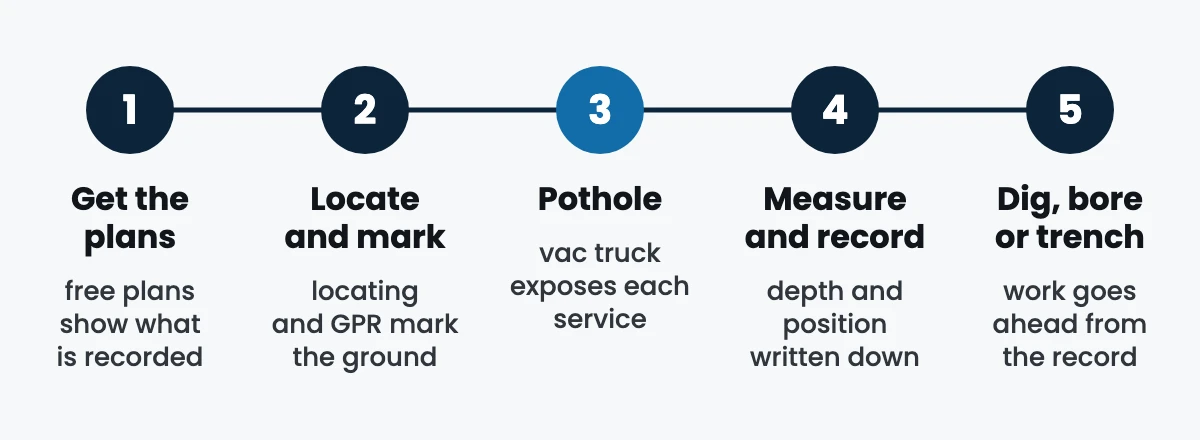
- Get the plans. The free plans show what asset owners have recorded and where to start looking.
- Locate and mark. Locating and GPR mark the ground along your dig line, so our operator knows where each pothole goes and where to set up the truck and hose.
- Pothole. The vac truck exposes each service. On concrete or asphalt, a machine lifts only the surface, as Ausgrid's standard limits it. Then the water lance loosens the soil and suction lifts the spoil into the tank.
- Measure and record. With the service in sight, our operator writes down its depth and position. Jemena's guideline describes the same idea for gas: visually identify the main, measure its depth and mark the centreline on the ground.
- Dig, bore or trench. The work goes ahead from the record, with machines kept out of the distances the asset owner sets.
Ausgrid and Jemena also set nozzle distances and water pressure limits near their assets. Our operator works to the owner's conditions for your site, so send the owner's pack with your plans when you book.
One hole is rarely the whole job. Ausgrid wants potholes close enough together to identify all cables, conduits and services and the profile between them, so a long trench or bore usually means a series of holes.
The codes and Ausgrid also accept hand digging with insulated or non-conductive tools. A vac truck does the same job and takes the spoil away as it goes, which makes vac truck potholing a clean choice for tight or busy work areas. Read more on our vacuum excavation and non-destructive digging pages.
Know what is down there before you dig
Call the Newcastle team any time to book a vac truck and operator for potholing, or send your plans and photos for a quote.
What gets recorded
The record is the point of potholing: for each hole, what was found, where and how deep. Agree the record you need when you book. A useful one notes:
- where each pothole is, tied to the plans or the ground marks;
- what service was found, or that nothing was there;
- the depth from the surface to the top of the service;
- which way it runs, and anything that was not on the plans;
- photos of the exposed service.
In BYDA's summary of the AS 5488 quality levels, the highest level is "Validation of assets by visual means (non-destructive digging etc)". Keep the record with your plans and pass it to whoever does the main excavation. The Excavation work code also says a safe work method statement (SWMS) must be prepared for excavation work involving underground services.
Where the spoil goes
The spoil and water go straight up the suction hose into the truck's tank, so no mud pile is left in the work area. From there, the NSW EPA says the Protection of the Environment Operations Act 1997 requires waste to be transported to a place that can lawfully accept it, and both the waste owner and the transporter are responsible for proving it went there.
Tell us about anything unusual in the ground, such as fill or contamination, so disposal is planned with the job. Our liquid waste removal page covers slurry in more detail.
What to send when you book
Each potholing job is planned from the site details you send. Have these ready:
- Address and work area: where the dig, bore or trench will run.
- Current Before You Dig plans: every response, checked for expiry. BYDA asks for enquiries at least one day before the job is due to begin.
- Any locator or GPR mark-out, or ask us to do it first.
- The job and its depth: footings, a connection, a bore or a trench, and how deep the design goes.
- The asset owner's conditions: such as Ausgrid's written consent within 2 m of a transmission cable or a Jemena standby. Some work near Ausgrid cables, such as boring within 2 m, needs notice to Ausgrid first, so check its requirements early.
- Private services the owner or occupier knows about.
- Access and surface: where the truck can stand, gates, overhead obstacles, and any concrete or asphalt to lift.
- Your SWMS and induction details.
Call (02) 4012 2214 to talk it through, or upload photos or a site plan with the quote form. Our vac truck site preparation checklist covers access and set-up, and plumbers can read how hydro excavation helps on plumbing jobs. The Newcastle team offers a 24/7 service, including on-site attendance for urgent and after-hours jobs. Timing depends on the job, its location and the schedule, and is confirmed when the work is scoped.
Book potholing before you dig
Send your plans and site details and we will plan the vac truck and operator around your job in Newcastle, Lake Macquarie or the Hunter.
Frequently asked questions
What is potholing?
Potholing is digging a small hole, by hand or with a vac truck, to expose a buried service and confirm where it is, or that nothing is there, before excavation starts.
Do I still need plans if I pothole?
Yes. Current underground services information must be obtained before excavation, and Before You Dig Australia plans are the usual source. The plans show where to pothole; potholing confirms what they show.
How deep can a vac truck pothole?
As deep as needed to see the service. The codes set no standard depth, only a pre-determined one for each job. SafeWork NSW gives typical depths of 450 to 750 mm for low voltage cables and 600 to 1000 mm for high voltage distribution, but real depths vary. Tell us the depth your plans or design call for and the job is planned around it.
Does potholing replace service locating?
No, they work together. A locator traces and marks services on the ground, then potholing verifies them by exposing them. That is the order SafeWork NSW's electric lines code describes, with the asset owner's permission or supervision.
What happens to the spoil?
It goes into the vac truck's tank as the hole is dug. NSW EPA rules require waste to go to a place that can lawfully accept it, and the owner and transporter are both responsible for that.
This guide is general information, not safety or legal advice. Codes and asset owner conditions change, so check the current SafeWork NSW codes, your Before You Dig Australia plans and the asset owner's pack for your site before work starts. Sources were checked in November 2026.