There is no single depth for buried services in NSW. Asset owners set minimum cover for new work, and the safety codes list typical ranges, but the depth of a pipe or cable on your site today depends on when it went in, what has been built or dug around it since, and where it had to go around something. Hunter Water's own underground services standard puts it plainly: no law requires cables or services to be laid at a certain depth.
So use the figures below to plan, and confirm the real depth by exposing the service before you dig. That is the work Rapid Vac Trucks Newcastle does: a vac truck and an experienced operator uncover each service with water and suction, and record how deep it is, so your dig goes ahead from facts.
Key takeaways
- Typical depths are a planning guide, not a promise about your site.
- In NSW, low voltage power cables are typically 450 to 750 mm deep and ordinary gas mains need at least 600 mm of cover in the road reserve.
- Hunter Water lists water pipelines at a minimum of 450 mm and sewers anywhere from 600 mm to 10 metres.
- nbn asks for lead-in conduit on a property to be laid at least 300 mm down (450 mm under a driveway), and no deeper than 500 mm.
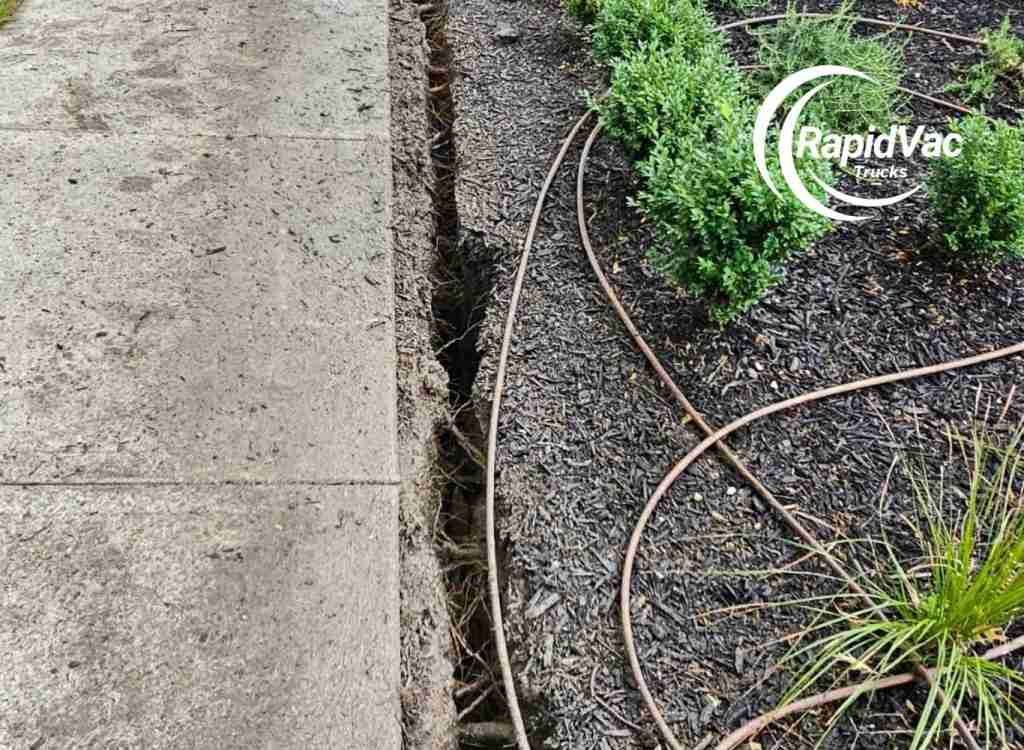
- Later footpath, driveway and garden works change the cover, and services rarely run in straight lines.
- The only reliable depth is the one you measure once the service is exposed.
How deep are services buried? The short answer
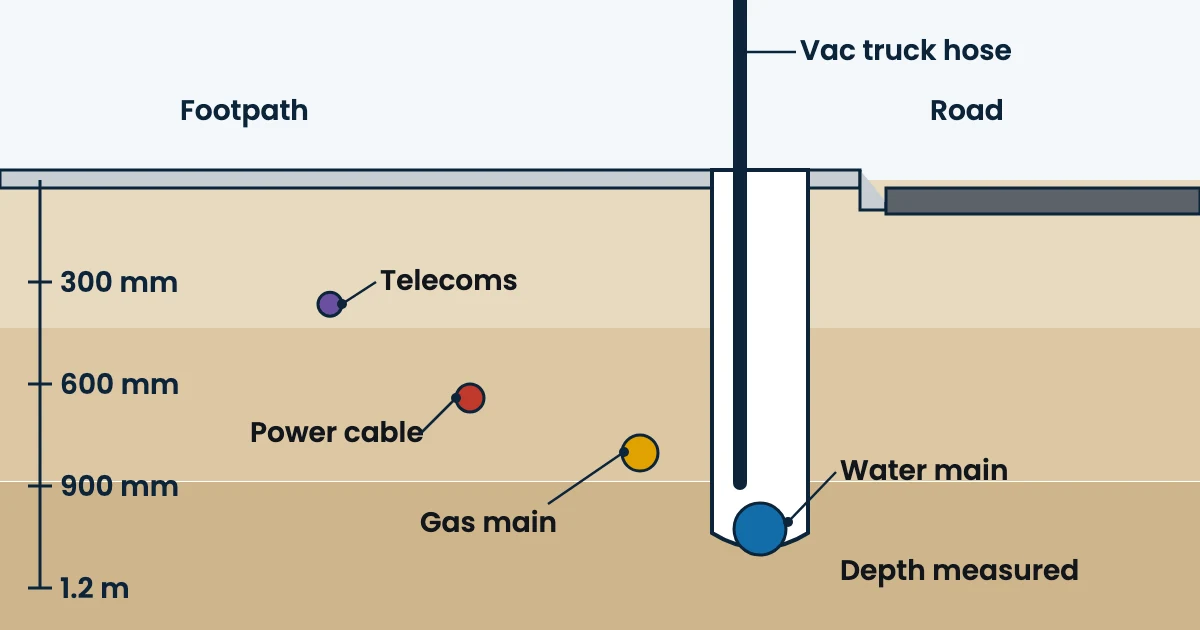
Most services in a Newcastle street or front yard sit somewhere between about 300 mm and 1.2 m below the surface, and sewers can go much deeper. That range comes from the asset owners' own rules and the current SafeWork NSW code, set out service by service in the next section.
The catch is that these numbers describe how a service should be laid when it is new. They do not tell you where an old cable sits under a footpath that has been rebuilt twice. The Before You Dig Australia FAQs explain that pipes and cables are not laid in straight lines, mainly because of obstacles in the way when they went in, and say it is important never to assume their depth or alignment.
Typical depths in NSW, service by service
These figures come from the people who own the networks around Newcastle and Lake Macquarie, from nbn, and from the current SafeWork NSW code for work near electric lines. Each one is a typical range or a minimum cover for new work. Cover is measured from the surface down to the top of the service.
| Service | What the figures say | Where it comes from |
|---|---|---|
| Low voltage power cables (up to 1,000 V) | Typically 450 to 750 mm deep. New low voltage conduits in a footway or driveway get 500 mm of standard cover. | SafeWork NSW electric lines code, Table 6; Ausgrid NS130, Table 3 |
| High voltage power cables (11 kV to 33 kV) | Typically 600 to 1,000 mm deep. New Ausgrid high voltage conduits (up to 11 kV) in a footway get 600 mm of standard cover. | SafeWork NSW electric lines code, Table 6; Ausgrid NS130, Table 3 |
| Power cables under local roads | New conduits under the carriageway of regional and unclassified roads get 750 mm of standard cover. | Ausgrid NS130, Table 3 |
| Gas mains (low and medium pressure) | Minimum cover of 600 mm in the road reserve, 750 mm under other roads and 1,200 mm under arterial roads and their adjacent road reserves. | Jemena guideline GAS-9899-GL-CN-001, Table 1 |
| Telecommunications cables in the street | Typically 450 to 600 mm deep, with other telecommunications assets down to 1,200 mm. | Hunter Water underground services standard, Appendix A |
| nbn lead-in conduit on your property | At least 300 mm deep, at least 450 mm under a driveway, and no deeper than 500 mm. | nbn pre-installation lead-in conduit guide |
| Water pipelines | A minimum of 450 mm deep. | Hunter Water underground services standard, Appendix A |
| Sewer pipelines | Anywhere between 600 mm and 10 metres deep. | Hunter Water underground services standard, Appendix A |
Two things stand out. First, the electricity code's own general row lists typical depths as "variable", and the same code notes that variations in alignment and depth may occur where cables were drilled in. Second, every figure in the table is about cover over a new installation. Ausgrid's NS130 standard even allows reduced cover with its approval where the standard depth cannot be met, so a cable can legitimately sit shallower than the headline number.
Read the full documents if your job runs close to a network: the SafeWork NSW Work near overhead and underground electric lines code, Ausgrid's NS130 cable laying standard (in its technical document library), Jemena's guideline for work around the gas network and nbn's lead-in conduit guide. Hunter Water's Underground and Overhead Services Standard (June 2024) sets out its own typical depths in Appendix A.
Why the real depth on your site is often different
The ground above a service changes long after the service goes in. Hunter Water's Underground and Overhead Services Standard (June 2024) warns that many services have been in the ground for years and that later earthworks, such as footpath and subdivision work or gardening, can alter a cable's apparent depth.
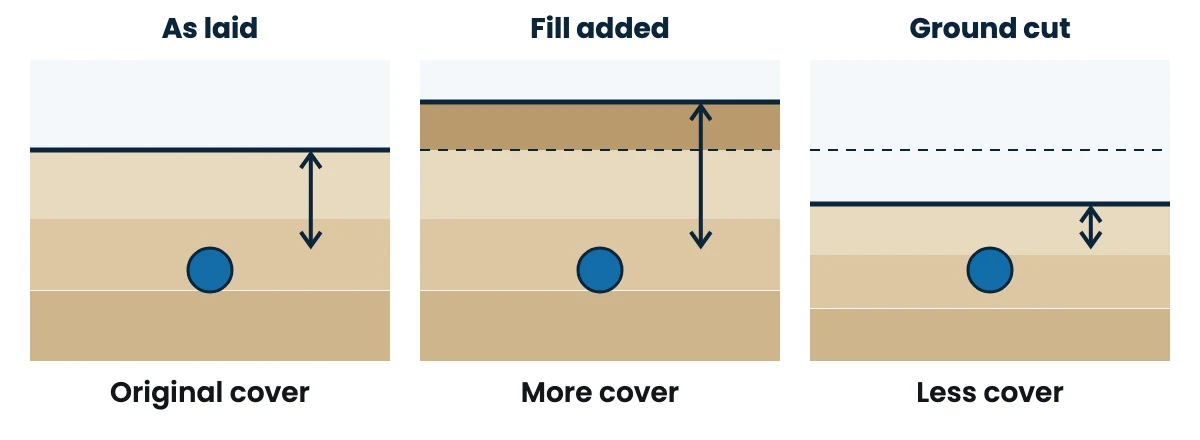
On a typical Newcastle job, that shows up in a few ways:
- Fill added on top. A new driveway, a raised garden bed or a regraded yard puts more soil over a service, so it sits deeper than it was laid.
- Ground cut away. A lowered footpath, a new crossover or a levelled block takes cover off, so a service can be much closer to the surface than the table suggests.
- Lines that bend. Services were laid around rocks, trees and other services, so the line and the depth can change along the run.
- Old work, older rules. A cable or pipe laid decades ago went in under the practice of its day, and records may not show what has happened since.
How close can you dig to a service?
The rules work on distance from the service, which is why its real depth matters. The SafeWork NSW electric lines code sets a no-go zone for powered excavation of 300 mm around low voltage cables and 600 mm around high voltage distribution cables. Inside those distances, the code allows hand tools that cannot damage or pierce the cable's outer sheath. To find the cable in the first place, the code says potholing can be done with hand tools or a vacuum excavation device, after contacting the asset owner for advice.
Gas, water and telecommunications owners set their own conditions, and those come with the plans you receive through Before You Dig Australia. If a gas main is in the work area, Jemena's guideline asks that any change to the depth of cover over its main goes to its engineers for review first. Read every response before the dig and follow the owner's instructions for your site.
How to find the real depth before you dig
Plans tell you what is near your site. Exposing the service tells you where it is and how deep it is. The usual order on a Newcastle job is:
- Lodge a free Before You Dig Australia enquiry and read every plan that comes back. Our guide to Dial Before You Dig in NSW explains what the plans show and leave out.
- Walk the site for clues: pit lids, meters, marker posts and patched trenches in the footpath.
- Locate and mark the services on the ground. Our service locating and ground penetrating radar work traces the lines before anything is dug.
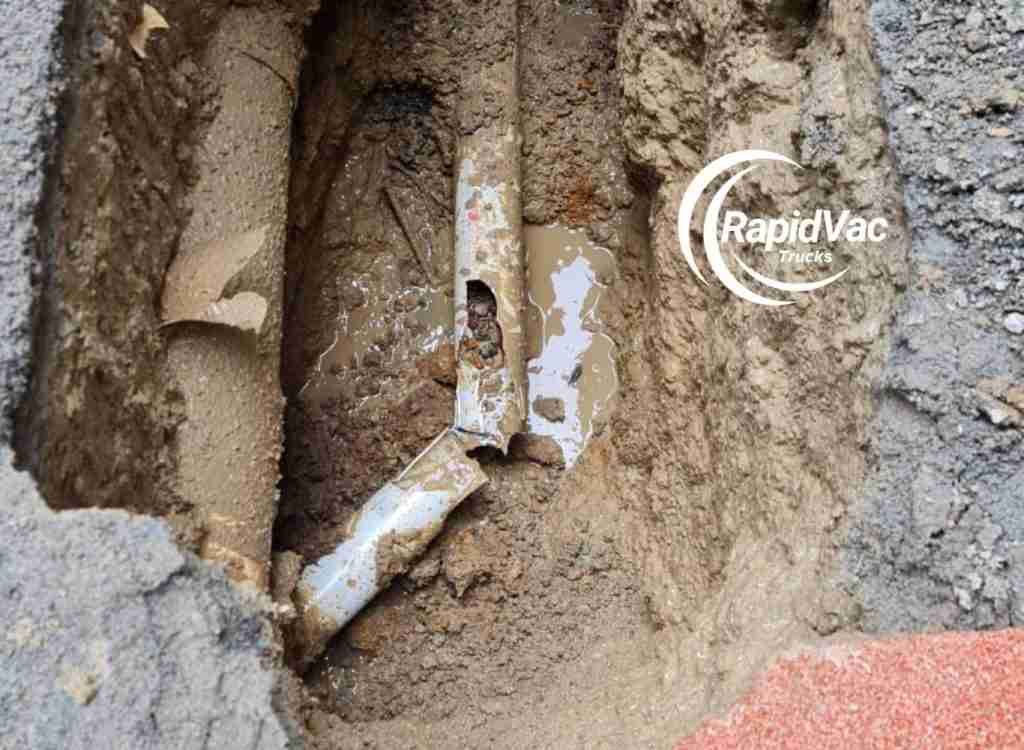
- Expose each service at the points that matter. Hunter Water recommends potholing at each asset crossing and at regular spacing along an asset, and names hydro vacuum extraction as one of the methods. Our potholing guide walks through how a vac truck crew does it.
- Record what you find: the service, its position and the depth to its top, so the main dig is planned around real numbers.
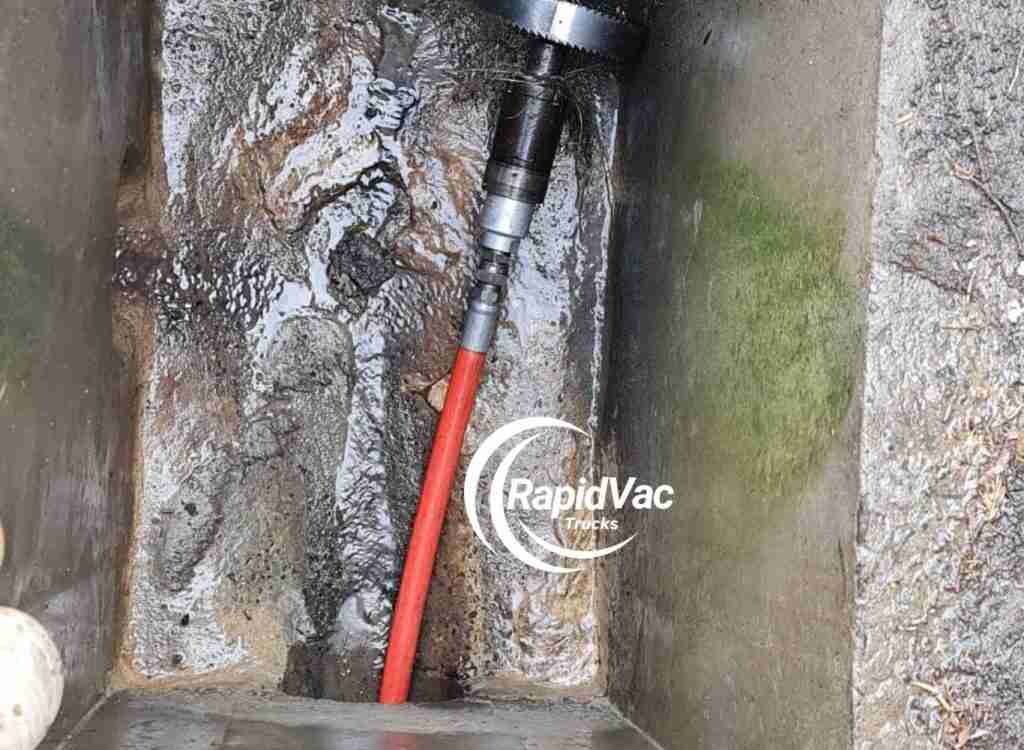
Step 4 is where a vac truck earns its place. Water loosens the soil and the truck's vacuum lifts it away, so the hole opens down to the service without a bucket anywhere near it. Our operator measures the depth with the service in sight and the spoil goes into the truck, not onto the site. You can read more about our vacuum excavation and non-destructive digging work, or call (02) 4012 2214 to book the crew for your site.
What to have ready when you call
These details let the crew plan where to expose services and how long the job needs:
- The job address and where on the site the dig is.
- Your Before You Dig Australia responses, or the date you lodged.
- What you are building or installing and how deep your design goes.
- Any locator marks already on the ground.
- Photos of the area, including access for the truck and any pit lids or meters.
- When you need the services exposed.
Call (02) 4012 2214 to talk it through, or upload your plans and photos with the quote form. You can also read more about the Newcastle team. The rate and any minimum charge are confirmed in the quote. The Newcastle team offers a 24/7 service, including on-site attendance for urgent and after-hours jobs. Timing depends on the job, its location and the schedule, and is confirmed when the work is scoped.
If a service is damaged, stop work and tell the asset owner straight away. The owner's contact details are on your Before You Dig confirmation. In a life-threatening situation, call 000.
Know the depth before the machine goes in
Rapid Vac Trucks Newcastle exposes services across Newcastle, Lake Macquarie, Charlestown, Mayfield, Glendale, Warners Bay and Maitland. Send your plans and we will plan the job with you.
Frequently asked questions
Is there a legal minimum depth for services in NSW?
Not one that tells you where an existing service is. Hunter Water's underground services standard says no law requires cables or services to be laid at a certain depth. Asset owners set minimum cover for their own new work, such as Ausgrid's 500 mm for new low voltage conduits in a footway, but older services and later earthworks mean the real depth varies.
How deep are gas lines buried in NSW?
For ordinary low and medium pressure gas mains, Jemena's guideline sets a minimum cover of 600 mm in the road reserve, 750 mm under other roads and 1,200 mm under arterial roads and their adjacent road reserves. The service pipe running into a property is a different case, so confirm its depth on site.
How deep are power cables buried?
The SafeWork NSW electric lines code lists typical depths of 450 to 750 mm for low voltage cables and 600 to 1,000 mm for high voltage distribution cables. The same code lists the general case as variable, so treat these as a guide.
How deep are water and sewer pipes buried?
Hunter Water's underground services standard lists water pipelines at a minimum of 450 mm and sewer pipelines anywhere between 600 mm and 10 metres, and says to pothole to confirm the location. Use those as a guide and confirm the depth on site.
How deep is nbn cable buried on my property?
nbn's lead-in conduit guide asks for the conduit to sit at least 300 mm below finished ground, at least 450 mm under a driveway, and no deeper than 500 mm. Older copper or other telecommunications cables may sit elsewhere. Confirm the actual depth on site before you dig.
Do Before You Dig plans show how deep a service is?
You should not rely on them for depth. Before You Dig Australia says never to assume the depth or alignment of pipes and cables. Exposing the service is how you confirm it.
Does a locator tell me the depth?
A locator traces the line and marks it on the ground, which tells you where to expose the service. Seeing the service is how you confirm its exact position and depth, and Before You Dig Australia notes that manual excavation, if the asset owner instructs it, may be needed to find the exact location.
This guide is general information, not safety or legal advice. Asset owner conditions and standards change, so check your Before You Dig Australia responses, the current SafeWork NSW codes and each owner's instructions for your site before work starts. The SafeWork NSW code, Jemena guideline and nbn guide were checked on 23 November 2026. Ausgrid NS130 (Amendment 9), the Hunter Water standard (Version 4, June 2024) and Before You Dig Australia guidance are cited as published.